You’ve built an amazing product. You’re getting customer traction. Your team is passionate and committed.
Then the penalty notice arrives. Rs. 50,000 for a missed deadline. Or worse—a potential investor walks away because your governance house isn’t in order.
Here’s the uncomfortable truth: brilliant ideas fail every day because of governance mistakes that could have been avoided in 30 minutes.
If you’re running a startup in Sri Lanka, here are five critical governance traps that catch even the smartest founders—and exactly how to sidestep them.
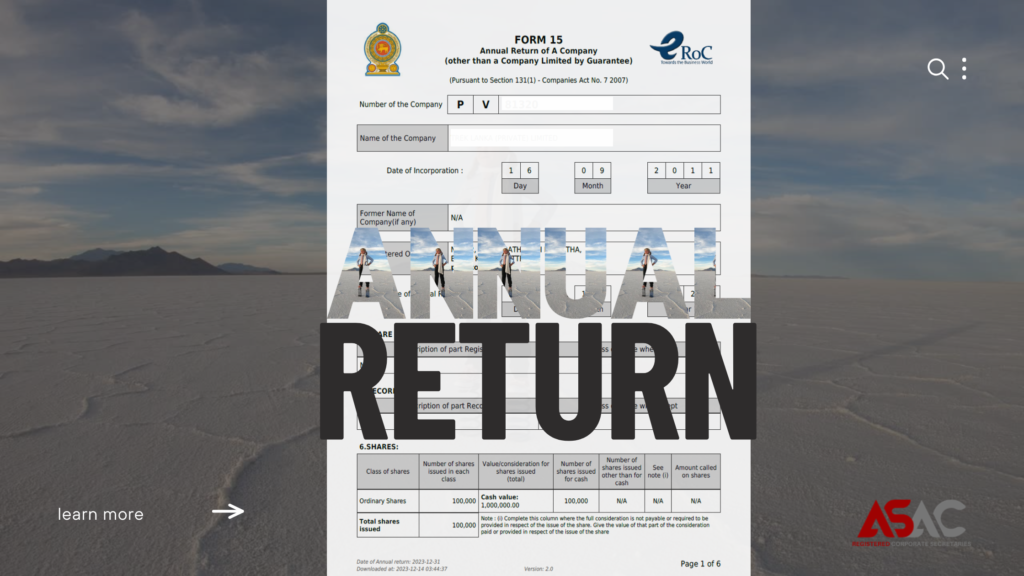
1. Delayed Annual Returns: The Silent Company Killer
The Mistake: “We’ll file it next month” becomes next quarter, then next year. Before you know it, your company is facing penalties of Rs. 50,000 or more, and in extreme cases, being struck off the register.
Why It Happens: Founders are focused on product development, customer acquisition, and fundraising. Annual returns feel like administrative paperwork that can wait. Spoiler alert: they can’t.
The Real Cost: Beyond monetary penalties, delayed annual returns can:
Prevent you from opening bank accounts
Block foreign investments or partnerships
Damage your reputation with potential investors
Create complications during due diligence
Lead to director disqualification
The Solution: Set up a compliance calendar on day one. Whether you use The Boardroom app, a simple Google Calendar, or work with a company secretary, create automated reminders 60 days before deadlines. Better yet, file early—there’s no prize for waiting until the last minute.
Pro Tip: The Registrar of Companies doesn’t care about your pitch deck. They care about your annual return being on time.
Annual Return Company Secretary Sri Lanka
2. Incomplete Board Minutes: Your Future Self Will Thank You
The Mistake: Either not maintaining board minutes at all, or keeping vague, incomplete records like “Discussed marketing strategy. All approved.”
Why It Happens: Early-stage startups often operate informally. Decisions happen over coffee, on WhatsApp, or during late-night coding sessions. Documenting them feels bureaucratic.
The Real Cost: When disputes arise (and they often do), incomplete minutes mean:
No legal proof of decisions made
Difficulty enforcing shareholder agreements
Complications during fundraising due diligence
Potential personal liability for directors
Inability to demonstrate compliance with your own articles
The Solution: Every board decision needs to be documented with:
Date, time, and location (even if virtual)
Attendees and absentees
Matters discussed with sufficient detail
Resolutions passed (exact wording matters)
Voting records
Any conflicts of interest declared
Action items and responsible parties
You don’t need a 10-page document for every meeting, but you do need clarity. If you can’t prove a decision was made properly, it may as well not have been made at all.
Template Tip: Create a standard board minutes template and fill it in immediately after each meeting—not three weeks later when details are fuzzy.
3. Shareholder Agreement Oversights: The Ticking Time Bomb
The Mistake: Operating without a shareholder agreement, or having one that doesn’t address real-world scenarios that startups face.
Why It Happens: “We’re all friends” is the most dangerous phrase in startup governance. Founders assume goodwill will prevail, or they delay creating proper agreements to avoid uncomfortable conversations.
The Real Cost: I’ve seen co-founder disputes destroy promising companies because:
No clear exit mechanisms existed
Equity vesting wasn’t documented
Decision-making authority was ambiguous
Intellectual property ownership was unclear
New investor entry terms weren’t predetermined
The Solution: Even if you’re starting with your best friend, university roommate, or sibling, you need a comprehensive shareholder agreement that covers:
Equity split and vesting schedules (including cliff periods)
Decision-making thresholds (what needs unanimous consent vs. majority)
Intellectual property assignment to the company
Non-compete and confidentiality obligations
Deadlock resolution mechanisms
Exit provisions (right of first refusal, drag-along, tag-along rights)
Founder departure scenarios (voluntary and involuntary)
Dilution protection for future funding rounds
Real Talk: The conversation about “what happens if one of us wants to leave” is uncomfortable at day one. It’s infinitely more uncomfortable at day 365 when it’s actually happening and nothing is in writing.
4. Registered Office Non-Compliance: More Than Just an Address
The Mistake: Using a residential address that changes when you move, not maintaining the registered office, or failing to receive and process official correspondence.
Why It Happens: Startups often use a founder’s home address to save costs, then forget to update it when they move. Or they use a virtual office without ensuring someone actually checks the mail.
The Real Cost: Missing critical correspondence can result in:
Unawareness of regulatory notices or penalties
Failure to respond to Registrar of Companies communications
Missing court summons or legal notices
Default judgments against the company
Involuntary strike-off from the register
The Solution: Your registered office must:
Be a physical location in Sri Lanka (not a PO Box)
Be accessible during business hours
Have someone responsible for receiving correspondence
Be updated with the Registrar within 14 days of any change
Maintain statutory registers and records
Cost-Effective Approach: If you’re not ready for dedicated office space, use your company secretary’s address or a professional registered office service. The annual cost is minimal compared to the risk.
Critical: Every piece of mail to your registered office should be reviewed within 48 hours. Regulatory deadlines don’t pause because you didn’t check the mailbox.
5. Poor Record-Keeping Practices: Death by a Thousand Paper Cuts
The Mistake: Scattered documents across email threads, Google Drives, physical files, and personal laptops. No centralized, organized system for corporate records.
Why It Happens: Record-keeping isn’t exciting. Founders prioritize customer-facing activities over administrative infrastructure, especially in the early days.
The Real Cost: Disorganized records lead to:
Inability to answer investor due diligence questions quickly
Missing documents during audits or regulatory reviews
Time wasted searching for contracts, resolutions, or certificates
Compliance failures due to overlooked requirements
Increased professional fees (lawyers and accountants charging more time)
Failed transactions because you can’t produce required documents
The Solution: Implement a document management system from day one:
Essential Records to Maintain:
Certificate of Incorporation and Articles
All board and shareholder resolutions
Share certificates and transfer documents
Statutory registers (directors, members, charges)
All contracts and agreements
Financial statements and tax returns
Correspondence with regulators
Intellectual property documentation
Digital Best Practices:
Use a centralized cloud storage system (with proper access controls)
Implement a clear naming convention (e.g., “2026-01-15_Board_Minutes_Meeting_005”)
Maintain both electronic and physical copies where required by law
Regular backups (the 3-2-1 rule: 3 copies, 2 different media, 1 offsite)
Access logs for sensitive documents
Annual record review and archiving
Technology Advantage: This is exactly why we invested in The Boardroom app—digitizing corporate records isn’t just about convenience; it’s about reducing existential risk for your company.
The Common Thread: Prevention is Cheaper Than Cure
Here’s what I’ve learned managing 400+ clients across 16 years:
Every single governance failure I’ve witnessed was preventable.
The founders who succeed aren’t necessarily smarter or more talented. They’re the ones who:
Treat compliance as a competitive advantage, not a burden
Build systems before they desperately need them
Seek professional advice early, not during a crisis
Invest in governance infrastructure alongside product development
Understand that “moving fast and breaking things” shouldn’t include regulatory compliance
Your Governance Health Check
Ask yourself these five questions:
✅ Are all our statutory filings up to date?
✅ Can we produce complete board minutes for every significant decision made?
✅ Do we have a comprehensive, legally sound shareholder agreement?
✅ Is our registered office compliant and properly maintained?
✅ Could we pass an investor due diligence review tomorrow?
If you answered “no” or “I’m not sure” to any of these, you have work to do.
The Bottom Line
Building a startup in Sri Lanka is hard enough without adding self-inflicted governance wounds. The companies that scale successfully—the ones that attract international investment, survive co-founder transitions, and build lasting value—all have one thing in common: they got the fundamentals right early.
You don’t need a perfect governance structure on day one. But you do need a functional one that grows with your company.
The best time to fix these five mistakes was at incorporation. The second-best time is today.
Over to you: Which of these five mistakes have you encountered (or made)? What governance challenges are you currently facing? Share in the comments—your experience might help another founder avoid a costly mistake.
And if you’re unsure where your company stands, that’s what professionals are for. Don’t wait for the penalty notice to arrive.






 Company Registration
 Tax Registration
 Labour Registration
 Imports and Export Registration
 Trade Marks
 Company Secretary
 Meetings
 Audit & Assurance
 Tax Compliance
 Payroll Processing
 File Search