


Circular Board Resolutions – Validity Under Sri Lankan Law Are circular board resolutions valid if not all directors sign? Learn what Article 30 of the Model Articles (First Schedule, Companies Act No. 07 of 2007) actually requires.
Key Takeaway: Under Article 30 of the Model Articles (First Schedule to the Companies Act No. 07 of 2007), read with Section 215, a circular board resolution is only valid when signed by all directors entitled to vote — not a majority, not most — all of them. Certifying a resolution before directors meet this condition is not a shortcut; it is a governance failure with serious legal consequences.
For any company operating in Sri Lanka, the circular board resolution is a familiar administrative tool. When directors need a board decision without the delay of convening a formal meeting, they circulate a resolution for signing. On the surface, it appears efficient. However, in practice — when companies ignore the requirements of the Companies Act — it becomes one of the most dangerous documents a company produces.
I have been in practice as a Chartered Corporate Secretary since 2008. Over the years, I have observed a pattern that concerns me deeply: companies certifying circular resolutions without meeting the legal requirements of Article 30 of the Model Articles (First Schedule to the Companies Act No. 07 of 2007). In some cases, officers obtain the company secretary’s certification before even a single director has signed.
This article explains what the law actually requires. Furthermore, it explains why shortcuts in this area carry serious legal and financial risk. Every director, officer, and company secretary must understand these obligations to protect their company.
What Is a Circular Board Resolution? (And What the Law Actually Says)
A circular board resolution — also called a written resolution — allows a board of directors to pass a resolution by obtaining each director’s signature on a written document. Consequently, directors avoid the need to vote at a physical meeting.
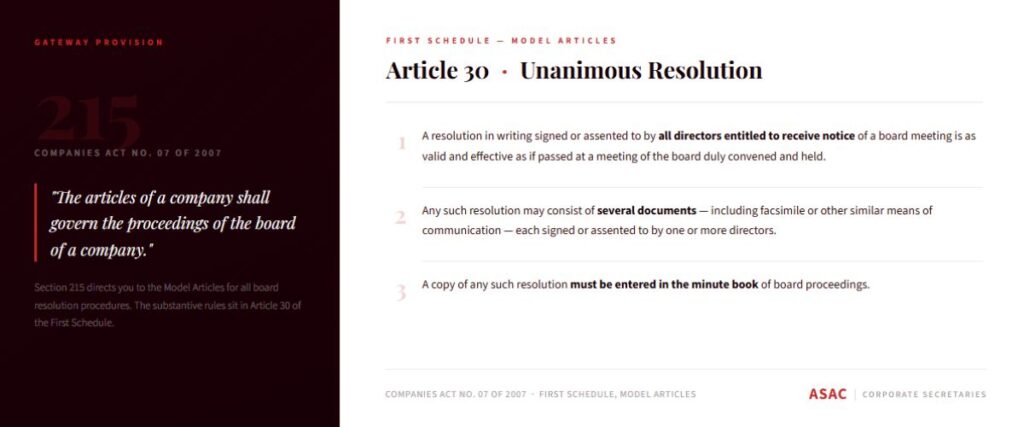
In Sri Lanka, Article 30 of the Model Articles (First Schedule to the Companies Act No. 07 of 2007), read with Section 215, governs this mechanism. Article 30 states that a written resolution signed or assented to by all directors entitled to receive notice of a board meeting carries the same legal force as one passed at a duly convened board meeting. Directors must be entitled to receive notice and to vote. Both conditions apply.
Article 30, First Schedule — Companies Act No. 07 of 2007
All directors entitled to receive notice of the board meeting and to vote on the resolution must sign or assent to it. A majority of signatures is not sufficient. Additionally, the resolution may consist of several documents, each signed or assented to by one or more directors.
For companies operating under the Model Articles, as most Sri Lankan private companies do — Article 30 contains no provision for a “majority” written resolution. Companies with bespoke articles should verify their specific provisions. Either way, the unanimous signature requirement is what distinguishes a valid circular board resolution from an invalid one — and the consequences of getting this wrong are significant.
The Governance Gap: What Is Actually Happening in Sri Lankan Companies
Problem 1 — Certifying Circular Board Resolution Without All Director Signatures
The most common failure is the company secretary certifying a circular resolution as duly passed when not all entitled directors have signed. This happens because of commercial urgency, misunderstanding of the law, or direct pressure from management. In every case, the result is the same: a legally void resolution that cannot serve as authority for any action the company takes.
Legal Consequence: A circular resolution lacking all required signatures becomes void under Article 30 of the Model Articles. Therefore, any company action taken on the basis of that resolution — opening a bank account, signing a contract, obtaining a loan — may face challenge as unauthorised.
Problem 2 — Officers Obtaining the Company Secretary’s Signature Before Directors Sign
This is an even more serious governance failure. In some companies, officers approach the company secretary to certify a circular resolution before a single director has signed it. They reason that collecting the certification first will save time. However, this is not a procedural shortcut — it is the creation of a false document.
The company secretary’s certification is a declaration to the world — to banks, lenders, counterparties, and courts — that the board has passed a resolution. Furthermore, certifying a resolution that bears no director signatures is a false declaration. It creates an instrument that purports to evidence a board decision that has never been made.
Warning to Company Secretaries: Your certification is a legal act, not an administrative formality. Issuing it prematurely — under pressure or otherwise — may expose you to criminal liability under Section 511 of the Companies Act No. 07 of 2007, which applies where a false statement is made willfully and knowingly. Pressure from management does not absolve you.
Scenario 1: Opening a Bank Account on an Invalid Circular Board Resolution
The Situation
ABC (Pvt) Ltd has three directors. Directors prepare a circular board resolution to open a new operating account. Two directors sign. The third — who is overseas — is unreachable. The finance manager pressures the company secretary to certify immediately so the bank submission is not delayed. The company secretary certifies. As a result, the account opens.
What Happens Next: The third director returns and discovers the account. She disputes it and alleges misappropriation through it. The resolution — missing her signature — is void under Article 30 of the Model Articles. Consequently, the company cannot rely on it as authority. Transactions through the account may face challenge. The company secretary faces personal liability. Furthermore, the bank faces exposure for acting on a defective resolution.
Scenario 2: Obtaining a Loan Facility — A Falsely Certified Resolution
The Situation
XYZ (Pvt) Ltd urgently needs a short-term loan. The CFO prepares a circular resolution to authorise the borrowing and pledge assets as security. To “save time,” the CFO obtains the company secretary’s certification first — before approaching any director for signature. The company draws the loan and pledges assets.
What Happens Next: Two directors claim they never signed and had no knowledge of the resolution. The certified resolution — signed by the secretary before any director — is produced in proceedings. The resolution is void. Therefore, the lender struggles to enforce the security. The CFO may face personal liability for misrepresentation. Additionally, the secretary faces criminal liability for false certification under Section 511.
Scenario 3: Entering a Major Contract Without a Valid Board Authorisation
The Situation
DEF (Pvt) Ltd has four directors. Directors prepare a circular resolution to authorise a five-year supply agreement worth LKR 500 million. One director — who has a known interest in a competing bid — deliberately does not receive the circular. Three directors sign. The secretary certifies. The company executes the contract.
What Happens Next: The excluded director discovers the contract and challenges it. He was entitled to receive notice under Article 30 of the Model Articles. His deliberate exclusion voids the resolution. As a result, the contract faces challenge. The counterparty, already in performance, claims damages. Furthermore, directors face breach of fiduciary duty claims. The company secretary — who certified without verifying that all entitled directors received the circular — is also implicated.
The Full Legal Framework — Key Sections of the Companies Act No. 07 of 2007
| Section | Subject | Relevance to Circular Resolutions |
|---|---|---|
| Article 30, First Schedule + S.215 | Unanimous written resolution — primary governing provision | The primary governing provision. Requires ALL entitled directors to sign. Sets out the unanimous signature requirement. |
| Article 30(3), First Schedule | Minutes of board resolutions | Requires circular resolutions to be recorded in the company’s minute book as part of its statutory records. |
| Section 187 | Directors’ Duties | Directors must act in good faith and in the best interests of the company. Circumventing the circular resolution process may breach this duty. |
| Articles 25–28, First Schedule | Board meeting procedure (notice, quorum, voting) | Where urgency is genuine, an emergency board meeting is the correct alternative — not a defective circular resolution. |
| Section 192 | Conflict of Interest | A director with a conflict of interest must disclose it. A conflicted director may be excluded from voting — but the exclusion must be properly documented, not used as a pretext to avoid an objection. |
| Section 189 | Directors’ standard of care (for officer liability angle) | Officers — including company secretaries — may be personally liable for acts done in contravention of the Act. |
A Compliance Checklist for Every Circular Board Resolution
Every company should adopt a formal internal procedure for circular resolutions. This checklist should be followed without exception:
- Step 1: Prepare the circular resolution in proper written form clearly stating the matter to be resolved. (Article 30, First Schedule)
- Step 2: Identify ALL directors and confirm who is entitled to receive notice and vote. (Article 30, First Schedule)
- Step 3: Check for conflicts of interest and document accordingly. (Section 192)
- Step 4: Send the circular to ALL entitled directors simultaneously — never selectively. (Article 30, First Schedule)
- Step 5: Collect signatures from ALL entitled directors before any certification. (Article 30, First Schedule)
- Step 6: Do NOT certify the resolution until ALL required signatures are obtained. (Article 30, First Schedule)
- Step 7: Enter the signed resolution in the company’s board minute book. (Article 30(3), First Schedule)
- Step 8: If urgency prevents collecting all signatures, convene a board meeting instead. (Articles 25–28, First Schedule)
Frequently Asked Questions
Q: Can a circular resolution be passed with a majority of directors’ signatures in Sri Lanka?
No. Under Article 30 of the Model Articles (First Schedule to the Companies Act No. 07 of 2007), read with Section 215, a circular (written) resolution requires the signatures of ALL directors entitled to receive notice of the board meeting and to vote. A majority is not sufficient. This is one of the most commonly misunderstood requirements of the Act.
Q: What happens if a director is overseas and cannot sign the circular resolution?
If a director entitled to vote cannot be reached, the circular resolution cannot be validly passed. The company has two lawful options: wait until all signatures are obtained, or convene a board meeting in accordance with Articles 25–28 of the Model Articles (First Schedule) where a quorum may suffice. Using the circular resolution with incomplete signatures is not a lawful option.
Q: Can a company secretary be personally liable for certifying an invalid circular resolution?
Yes. Under Section 511 of the Companies Act No. 07 of 2007, any person who wilfully makes a false statement in a document required by the Act is guilty of an offence. A company secretary’s certification is such a document. A false one carries a penalty of up to LKR 1 million or imprisonment up to five years or both.
Q: Does a director with a conflict of interest need to sign a circular resolution?
Under Section 192, a director who is disqualified from voting due to a conflict of interest need not sign. However, the conflict must be properly disclosed and documented. A director cannot be excluded simply to avoid an inconvenient objection — the exclusion must follow due process.
Q: Is there a difference between a circular resolution and an ordinary board resolution?
Yes. An ordinary board resolution is passed at a board meeting by a majority of directors present (subject to quorum requirements). A circular resolution under Article 30 of the Model Articles (First Schedule) is passed outside a meeting but requires unanimity among all entitled directors. Both have equal legal effect when validly passed.
A Direct Message to Directors, Officers, and Company Secretaries
To Directors:
Your signature on a circular resolution is not a formality. It is your exercise of a fiduciary duty. Before signing, understand what you are authorising. If you discover a resolution has been certified purportedly in your name without your signature, investigate immediately and seek legal advice.
To Officers (CEOs, CFOs, General Managers):
Obtaining the company secretary’s certification before directors have signed is not a time-saving measure — it is the creation of a false instrument. The lawful solution to urgency is to convene a board meeting in accordance with Articles 25–28 of the Model Articles (First Schedule), not to rely on a defective circular resolution. Furthermore, any officer who pressures a company secretary to certify prematurely exposes themselves, the company, and the secretary to serious liability.
Your Role as Gatekeeper: A Message to Company Secretaries
You are the gatekeeper of the circular resolution process. Do not certify until you have personally verified all entitled directors have signed. If someone pressures you to certify prematurely, decline in writing and document the request. Your professional integrity and your personal liability depend on holding this line.
The Real Cost of Getting Circular Resolutions Wrong
The real costs are serious. Invalid bank accounts. Unenforceable security. Challenged contracts. Personal liability for directors and officers. Reputational damage. These are the consequences of getting this wrong.
Conclusion
The circular board resolution is a legitimate and efficient governance tool — when directors use it correctly. Article 30 of the Model Articles (First Schedule to the Companies Act No. 07 of 2007), read with Section 215, sets out clear, non-negotiable requirements: all directors entitled to vote must sign or assent before anyone can validly certify and rely upon the resolution.
When companies bypass these requirements in the name of urgency or convenience, they do not save time — they create liability. Good governance is not about adding process for its own sake. Instead, it is about protecting the company, its shareholders, its directors, and its officers from avoidable risk. In summary, on the question of circular resolutions, the law is clear. Compliance is non-negotiable.



 Company Registration
 Tax Registration
 Labour Registration
 Imports and Export Registration
 Trade Marks
 Company Secretary
 Meetings
 Audit & Assurance
 Tax Compliance
 Payroll Processing
 File Search