

Foreign company registration Sri Lanka is not only possible — in most sectors, foreigners can own 100% of a Sri Lankan company without a local partner. However, the rules vary by industry, investment size, and company structure.
This guide answers the key questions foreign investors ask before setting up in Sri Lanka. It covers ownership rules, restricted sectors, BOI requirements, and the steps to register correctly from day one.
Foreign Company Registration Sri Lanka: The Short Answer
Sri Lanka actively welcomes foreign direct investment. The government permits 100% foreign ownership in most business sectors. Furthermore, the entire registration process runs online through the eROC platform, making it accessible to investors based anywhere in the world.
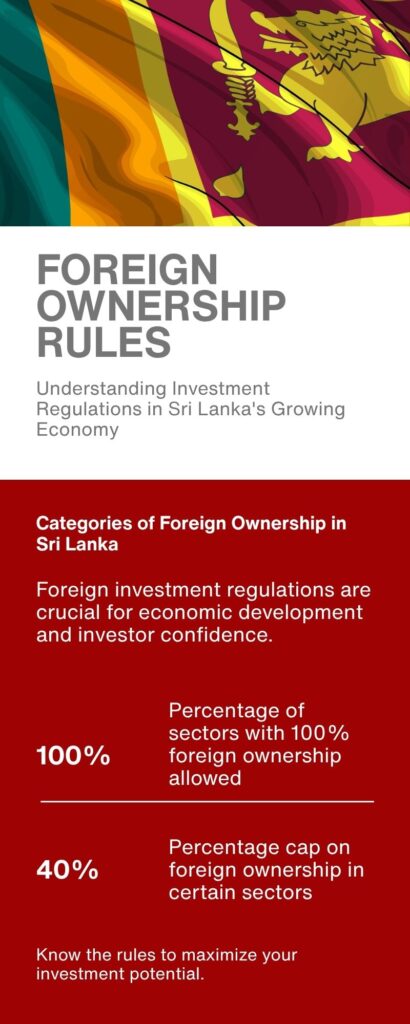
However, not every sector allows full foreign ownership. Some industries cap foreign shareholding at 40%. Others are reserved exclusively for Sri Lankan nationals. Knowing your category before you begin is critical. Choosing the wrong structure creates delays, legal exposure, and in some cases, mandatory restructuring later.
Sectors That Permit 100% Foreign Ownership
If your business falls into any of the following industries, you can proceed with 100% foreign ownership. No local partner is required.
Information Technology and Software Development. This is one of the most popular sectors for foreign investors. Full ownership applies with no minimum capital requirement.
Business Process Outsourcing (BPO). Sri Lanka has a well-established BPO industry. It offers a skilled, English-speaking workforce and full foreign ownership.
Tourism and Hospitality. Hotels, resorts, and travel-related services allow 100% foreign ownership. However, certain approvals from the Sri Lanka Tourism Development Authority may apply.
Construction and Infrastructure. Foreign companies can own 100% of construction firms. Large-scale projects may also require BOI registration depending on investment size.
Accounting and Professional Services. Audit, advisory, and consultancy firms can be fully foreign-owned.
Manufacturing. Most manufacturing categories permit full foreign ownership. However, defence manufacturing is excluded.
Food and Beverage Production. Foreign investors can establish fully-owned food manufacturing and processing operations.
Logistics. Full ownership applies to logistics operations. Shipping agencies, however, fall under the 40% cap.
Healthcare Services. Private hospitals, clinics, and medical laboratories all allow full foreign ownership.
If your business sits in any of these sectors, foreign company registration Sri Lanka as a 100% foreign-owned Private Limited Company is straightforward.
Sectors With a 40% Foreign Ownership Cap
Certain industries restrict foreign ownership to a maximum of 40%. As a result, a Sri Lankan national or entity must hold at least 60% of the shares. These sectors include:
- Travel Agencies and Tour Operators
- Freight Forwarding and Shipping Agencies
- Mass Communication and Media
- Primary and Secondary Education
- Timber-Based Industries
- Mining and Quarrying
- Agriculture and Farming
- Coastal Shipping
If your business operates in any of these areas, you need a local joint venture partner with the majority stake. Furthermore, structure this correctly from the outset. Transferring shares after incorporation in restricted sectors requires prior approval and can cause significant delays.
Sectors Reserved for Sri Lankan Nationals
A small number of industries prohibit foreign ownership entirely. These are:
- Pawn Brokering and Money Lending
- Coastal Fishing
- Retail Trade (unless investment exceeds USD 5 million)
- Security Services
- Lottery Operations
If your business falls here, direct foreign company registration Sri Lanka as an owner is not possible. In some cases, a branch office or representative office may offer an alternative path — however, both carry their own limitations.
BOI Approval for Foreign Company Registration Sri Lanka
The Board of Investment (BOI) is Sri Lanka’s primary regulatory body for foreign direct investment. Not all foreign-owned companies need BOI approval. However, specific categories do.
BOI approval is required when:
- Your company operates in retail, manufacturing, or as a branch office
- Your investment exceeds USD 250,000
- Your sector requires approval from a Line Ministry
BOI approval is not required when:
- Your company operates in a fully open sector such as IT, BPO, or professional services
- Your investment falls below the BOI threshold
- You incorporate as a standard Private Limited Company under the Companies Act No. 07 of 2007
The BOI process runs parallel to eROC registration — not instead of it. Companies that need BOI approval must complete both. Furthermore, BOI-registered companies may access tax incentives and investment guarantees that standard registrations cannot.
Best Structure for Foreign Company Registration Sri Lanka
For most foreign investors, the Private Limited Company (Pvt Ltd) is the best structure. It offers:
- Full legal recognition as a separate entity
- Limited liability protection for shareholders
- 100% foreign ownership in eligible sectors
- The ability to open corporate bank accounts and sign local contracts
- A clear compliance framework under the Companies Act No. 07 of 2007
However, some investors may consider alternatives depending on their goals:
Branch Office. This is an extension of the foreign parent company. It registers locally and the parent retains full liability. It suits firms testing the Sri Lankan market before full incorporation. Branch offices can be 100% foreign-owned.
Representative Office. This is a non-commercial presence for research, networking, or promotion. It cannot generate revenue or conduct trade. It requires Central Bank approval and suits companies exploring long-term opportunities.
Joint Venture. This is a partnership between a foreign entity and a Sri Lankan company or individual. It suits sectors with a 40% ownership cap. Joint ventures can be incorporated or unincorporated.
In almost all cases where full ownership is the goal, the Private Limited Company remains the most practical choice.
For most foreign investors, the Private Limited Company (Pvt Ltd) is the best structure. It offers:
- Full legal recognition as a separate entity
- Limited liability protection for shareholders
- 100% foreign ownership in eligible sectors
- The ability to open corporate bank accounts and sign local contracts
- A clear compliance framework under the Companies Act No. 07 of 2007
However, some investors may consider alternatives depending on their goals:
Branch Office. This is an extension of the foreign parent company. It registers locally and the parent retains full liability. It suits firms testing the Sri Lankan market before full incorporation. Branch offices can be 100% foreign-owned.
Representative Office. This is a non-commercial presence for research, networking, or promotion. It cannot generate revenue or conduct trade. It requires Central Bank approval and suits companies exploring long-term opportunities.
Joint Venture. This is a partnership between a foreign entity and a Sri Lankan company or individual. It suits sectors with a 40% ownership cap. Joint ventures can be incorporated or unincorporated.
In almost all cases where full ownership is the goal, the Private Limited Company remains the most practical choice.
Step-by-Step: Foreign Company Registration Sri Lanka via eROC
Step 1 — Confirm Your Sector and Ownership Eligibility
First, confirm whether your industry allows 100% foreign ownership, caps it at 40%, or restricts it entirely. Getting this wrong is the single most common and costly mistake foreign investors make. ASAC provides sector eligibility assessments as part of our pre-registration consultation.
Step 2 — Determine Whether You Need BOI Approval
Next, check if your sector or investment size triggers BOI requirements. If it does, start the BOI process first. BOI approval must be in place before incorporation in affected sectors. The minimum investment threshold for BOI registration is USD 250,000.
Step 3 — Reserve Your Company Name
Submit your preferred company name through the eROC portal. The name must be unique and must not resemble any existing registered entity. Name approval typically takes 2 to 3 business days. Furthermore, for companies with foreign shareholding, the name must appear in English, Sinhala, and Tamil in the Articles of Association.
Step 4 — Appoint a Licensed Company Secretary
All foreign-owned companies must appoint a local, licensed Company Secretary who resides in Sri Lanka. This is a non-negotiable legal requirement. The secretary manages compliance, maintains statutory records, and liaises with the Registrar on your behalf. ASAC fulfils this role for all foreign-owned client companies.
Step 5 — Establish a Registered Office Address
Every company needs a physical registered address in Sri Lanka. A PO Box or virtual address is not permitted. This address appears on your Certificate of Incorporation. If you do not have premises, ASAC provides a compliant registered office address facility for foreign-owned companies.
Step 6 — Prepare and Submit Registration Documents
You must complete, sign, scan, and submit the following through the eROC portal:
- Form 1 (Section 4): Company name, type, address, directors, and share structure
- Form 18 (Section 203): Director consent and certificate — one per director
- Form 19 (Section 221): Company Secretary consent and certificate
- Articles of Association: Your company’s governing document
Step 7 — Pay Fees and Await Incorporation
Pay the government registration fees through eROC by debit or credit card. The Registrar typically responds within 5 to 7 business days. Upon approval, your digital Certificate of Incorporation arrives by email.
Step 8 — Open a Corporate Bank Account
After incorporation, open a corporate bank account with a licensed Sri Lankan bank. Banks require your Certificate of Incorporation, Articles of Association, a board resolution authorising the account, and director and shareholder identification. ASAC helps foreign clients prepare all banking documentation and resolutions.
Key Requirements Unique to Foreign-Owned Companies
Foreign investors must meet several requirements that locally-owned companies do not face:
Certified passport copies. All foreign directors and shareholders must provide certified copies with all registration forms.
Articles of Association in three languages. The AoA must carry the company name in English, Sinhala, and Tamil for all companies with foreign shareholding.
Local Company Secretary. All foreign-owned entities must appoint one. This person must reside in Sri Lanka.
Physical registered address. A local Sri Lankan address is mandatory. Foreign addresses are not accepted.
Investor Visa. Foreign investors who invest at least USD 100,000 in a new or existing business may apply for a 5-year renewable investor visa. Moreover, a USD 200,000 investment qualifies for a 10-year renewable visa.
Can You Complete Foreign Company Registration Sri Lanka Remotely?
Yes. The entire process runs through eROC and requires no physical presence in Sri Lanka. ASAC regularly assists clients in Australia, the United Kingdom, the Middle East, Singapore, and across Europe to complete foreign company registration Sri Lanka without travelling to the country.
Documents requiring signatures can use digital signing tools such as Adobe Sign. Certified passport copies can be notarised locally in your home country and sent electronically. ASAC handles all submission, follow-up, and communication with the Registrar on your behalf.
Common Mistakes in Foreign Company Registration Sri Lanka
Not checking sector restrictions before incorporating. Registering as 100% foreign-owned in a sector with a 40% cap forces mandatory restructuring and potential penalties.
Using a PO Box as the registered address. This is not permitted. The Registrar will reject the application immediately.
Skipping the local Company Secretary. Many foreign investors try to avoid this step. However, applications without a qualified, licensed secretary will fail. It is a legal requirement with no exceptions.
Getting the shareholding structure wrong. Correcting share allocations after incorporation is complicated and requires regulatory approval. Therefore, get the structure right before you register.
Assuming BOI registration is always required. Many foreign investors over-complicate the process unnecessarily. In many sectors, standard eROC registration is all you need.
Frequently Asked Questions
Can a foreigner be the sole director and shareholder of a Sri Lankan company? Yes. A single foreign national can serve as both the sole director and sole shareholder of a Private Limited Company, provided the sector allows 100% foreign ownership.
Is there a minimum investment amount for foreign company registration Sri Lanka? No statutory minimum applies for standard Private Limited Company registration. However, BOI registration — required in certain sectors — has a minimum threshold of USD 250,000.
Can I complete foreign company registration Sri Lanka from overseas? Yes. The entire process runs remotely through eROC. ASAC handles foreign company registration Sri Lanka on behalf of clients worldwide without requiring physical presence in the country.
Do I need a Sri Lankan partner to register a company? Only if your sector caps foreign ownership at 40% or below. In all fully open sectors, 100% foreign ownership applies with no local partner required.
How long does foreign company registration Sri Lanka take? Name reservation takes 2 to 3 business days. Furthermore, once you submit all documents correctly, the Registrar completes incorporation within 5 to 7 business days. BOI approval runs on a separate timeline and may take several weeks.
What taxes apply to foreign-owned companies in Sri Lanka? Foreign-owned companies face the same tax obligations as locally-owned companies. These include Corporate Income Tax, VAT once turnover exceeds LKR 3 million per quarter, and applicable withholding taxes. Moreover, BOI-registered companies may access tax incentives depending on their sector and investment level.
How ASAC Can Help
Ananda Sirisena & Company (ASAC) has specialised in foreign company registration Sri Lanka since 1991. We are registered practicing Company Secretaries with over 30 years of experience assisting international investors to establish and operate companies in Sri Lanka.
Our team includes Chartered Secretaries, Chartered Accountants, and an Attorney. As a result, we cover the legal, governance, and financial dimensions of your setup comprehensively.
We handle everything. Sector eligibility assessment, BOI guidance, name reservation, document preparation, eROC submission, registered office address, company secretarial compliance, and corporate bank account documentation — all under one roof.
If you are ready to begin your foreign company registration Sri Lanka journey, or simply want to understand your options first, book a time to speak with our team below.
 Company Registration
 Tax Registration
 Labour Registration
 Imports and Export Registration
 Trade Marks
 Company Secretary
 Meetings
 Audit & Assurance
 Tax Compliance
 Payroll Processing
 File Search