


What Changed and Why It Matters
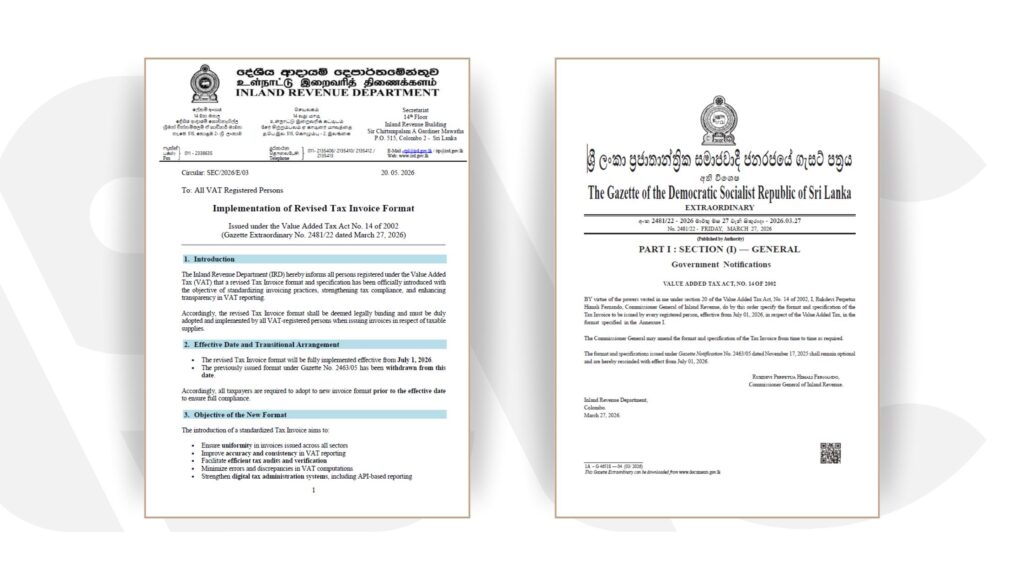
If your business is VAT-registered, tax invoice Sri Lanka rules changed on 1 July 2026 — whether your systems caught up or not. The Inland Revenue Department introduced a New VAT Invoice Format, legally binding format under Gazette Extraordinary No. 2481/22 (27 March 2026), with implementation guidance issued via Circular SEC/2026/E/03 (20 May 2026). So the old format under Gazette No. 2463/05 is now withdrawn.
Here’s exactly what changed, what’s mandatory, and what happens if your invoices fall short.
Why the Tax Invoice Sri Lanka Format Changed
The IRD introduced this revision to standardise invoicing across every VAT-registered business. According to the Circular, the goals are to:
- Ensure uniformity in invoices issued across all sectors
- Improve accuracy and consistency in VAT reporting
- Facilitate efficient tax audits and verification
- Minimise errors and discrepancies in VAT computations
- Strengthen digital tax administration systems, including API-based reporting
That last point matters most. This change connects directly to the IRD’s broader push toward real-time, API-based invoice reporting through RAMIS, their Revenue Administration Management Information System.
What’s Mandatory on Every Tax Invoice in Sri Lanka Now
The Invoice Must Say “TAX INVOICE”
Every invoice needs the words “TAX INVOICE” displayed prominently, in bold or highlighted text. Because of this, it’s now clearly distinguished from quotations, proforma invoices, or plain receipts.
Supplier and Purchaser Details
Both parties’ details must match their VAT registration certificates exactly:
- Taxpayer Identification Number (TIN) — 9 digits
- Registered business name
- Registered address
- Telephone number (optional)
The New Invoice Serial Number Format
This is the biggest structural change. Every tax invoice in Sri Lanka now needs a serial number in this format:
YYMMM_QQQQ_XXXXX
- YY — the last two digits of the year (26 for 2026)
- MMM — the first three letters of the month, uppercase (JUL for July)
- QQQQ — an identifier for your branch, department, unit, project, or customer classification. Letters, numbers, or both, 1 to 15 characters
- XXXXX — a sequential numeric serial number, digits only, continuing from your last invoice unless you restart it at a new month or year
Example: the first invoice issued in July 2026 by Branch 03 reads: 26JUL_BR03_1
The full serial number can’t exceed 40 characters, and it can’t contain spaces.
One exception is worth knowing. If you applied to the Commissioner-General before 1 July 2026 to integrate your ERP system with RAMIS for real-time invoice transmission — and you complete that integration by 31 December 2026 — the “YYMMM_QQQQ_” portion becomes optional for you.
Two Dates, Not One
Every invoice must show both an Invoice Date (when it’s issued) and a Date of Supply (when ownership actually passed). This distinction determines which tax period the transaction falls under.
A Real Description, Not “Miscellaneous”
The Circular is direct here. Vague terms like “items,” “products,” “services,” or “miscellaneous” don’t meet the standard. Instead, your description needs to clearly identify what was sold or provided — specific enough for both your customer and the IRD to understand the transaction at a glance. You’ll also need to state quantity using proper units: pieces, kilograms, litres, hours, or similar.
The Value Breakdown
Every invoice must show three figures in LKR, to two decimal places:
- Value of supply, excluding VAT
- VAT amount charged
- Total value, including VAT
If you invoice in a foreign currency with Central Bank approval, you’ll also need to convert and show all three figures in LKR, using the Central Bank’s selling rate on the invoice date.
VAT-Taxable Supplies Only
A tax invoice in Sri Lanka should only list supplies subject to VAT. Exempt or out-of-scope supplies shouldn’t appear on it — unless they’re directly tied to a taxable supply also on that invoice, in which case they can be disclosed separately.
What’s Optional on a Tax Invoice (New VAT Invoice Format)
A few fields add clarity but aren’t mandatory:
- Mode of payment
- Place of supply
- Total amount in words
- Additional notes or references
You’re also free to customise the layout, add your logo or branding, and include extra columns — as long as every mandatory element stays clearly identifiable.
What Happens If Your Tax Invoice Doesn’t Comply with New VAT Invoice Format
The Circular is direct about the consequences of a non-compliant tax invoice in Sri Lanka:
- Rejection of invoices for VAT input credit purposes
- Inconsistencies in your VAT returns
- Increased audit scrutiny
- Possible penalties under the VAT Act
Because non-compliant invoices can be rejected for input credit purposes, this isn’t just a formatting formality — a wrong invoice can directly cost your business money through disallowed input tax claims.
What This Means for Your Business
If you haven’t already, now’s the time to:
- Update your invoice template or accounting/ERP system to the new format
- Set up your serial numbering to follow the YYMMM_QQQQ_XXXXX structure
- Review your description fields, since generic line items won’t pass
- Confirm supplier and purchaser fields pull exactly from VAT registration records
- Build in LKR conversion fields if you invoice in foreign currency
This ties into your broader VAT obligations too — registration thresholds, monthly payment deadlines, and return filing frequency. For the full picture, see our article on recent VAT amendments in Sri Lanka, and our complete post-incorporation compliance guide for everything else on your calendar after registration.
For the primary source documents, the Inland Revenue Department publishes official circulars and gazette notices directly on their site.


 Company Registration
 Tax Registration
 Labour Registration
 Imports and Export Registration
 Trade Marks
 Company Secretary
 Meetings
 Audit & Assurance
 Tax Compliance
 Payroll Processing
 File Search